Download Picture Of Woman In New Mexico UPDATED
Download Picture Of Woman In New Mexico
Archivists Uncover New Mexico's Visual Past
Guardians of New United mexican states'south past, these archivists focus on visual history, the people depicted, and the mysteries that linger—one photo at a time.
DIRTY WITH AGE AND Pocket-size Enough to fit into the palm of a manus, the cased photograph held just three clues. Its technology—an ambrotype, essentially a glass negative placed on a dark background that turns the epitome to a positive—dated information technology to betwixt 1850 and 1865. The group of men wore uniforms, a hint that they could be soldiers. Corbels and vigas topped the wall behind them, signifying that they were probably in the Southwest, and maybe New Mexico itself.
The New Mexico History Museum'southward Palace of the Governors Photograph Athenaeum needed Civil War–era images for an showroom. Could its staff have stumbled upon a winner in a stash of near one meg photos, many of them orphaned and undocumented?
They needed to exercise some detective work to make sure.
Kickoff, a conservator treated its backing. Then archivist Hannah Abelbeck pulled a digital scan so detailed that, in one case the image was enlarged, the letters "FFC" could exist read on one of the hats. She posted information technology to the archives' Facebook page and asked its avid followers for help. I spotted what looked like a speaking bugle, a mutual tool among firefighters of a sure era. "FFC," said another, could hateful "Santa Fe Fire Company."
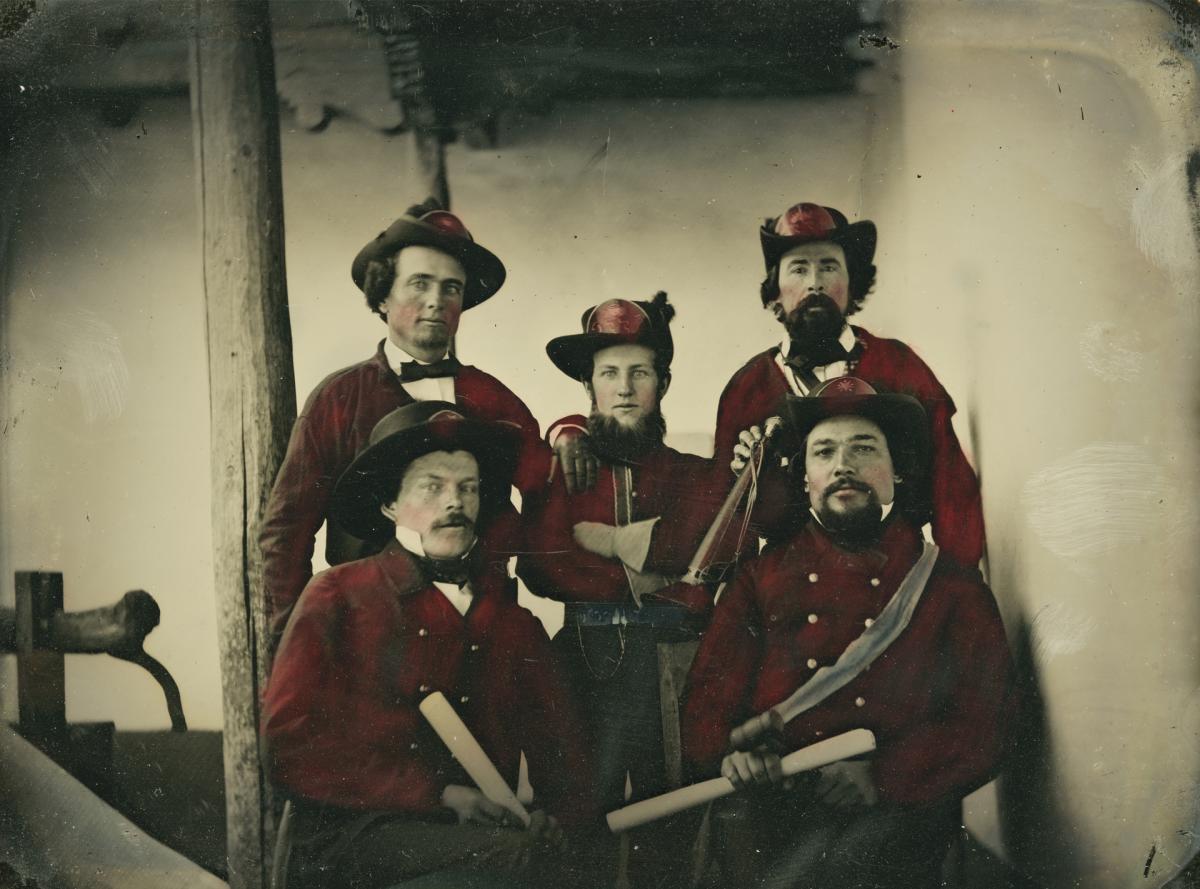
A group of v men from the Santa Fe Burn down Visitor, Santa Iron, New United mexican states, 1861-1880. Palace of the Governors Photo Athenaeum (NMHM/DCA) 145773.
"That gave me enough keywords that I could look for related documents," Abelbeck says. "I found that the Santa Fe Fire Company was incorporated in 1861 and got the names of people who signed the incorporation docs—which they may be holding in the picture. Then I tracked down images of those people and started matching them upward."
It indirectly filled the Civil War hole, as at least two of those pictured were known to be New Mexico volunteers, but it also added color to a fragment of New Mexico history, a task that falls, in part, to such guardians of our visual past. For researchers, authors, genealogists, people who honey exploring history, and fifty-fifty those who want affordable art for their walls, these repositories exist throughout the country in museums, universities, historical societies, and libraries. Some concord a few shoeboxes of snapshots. Others burst at the seams.
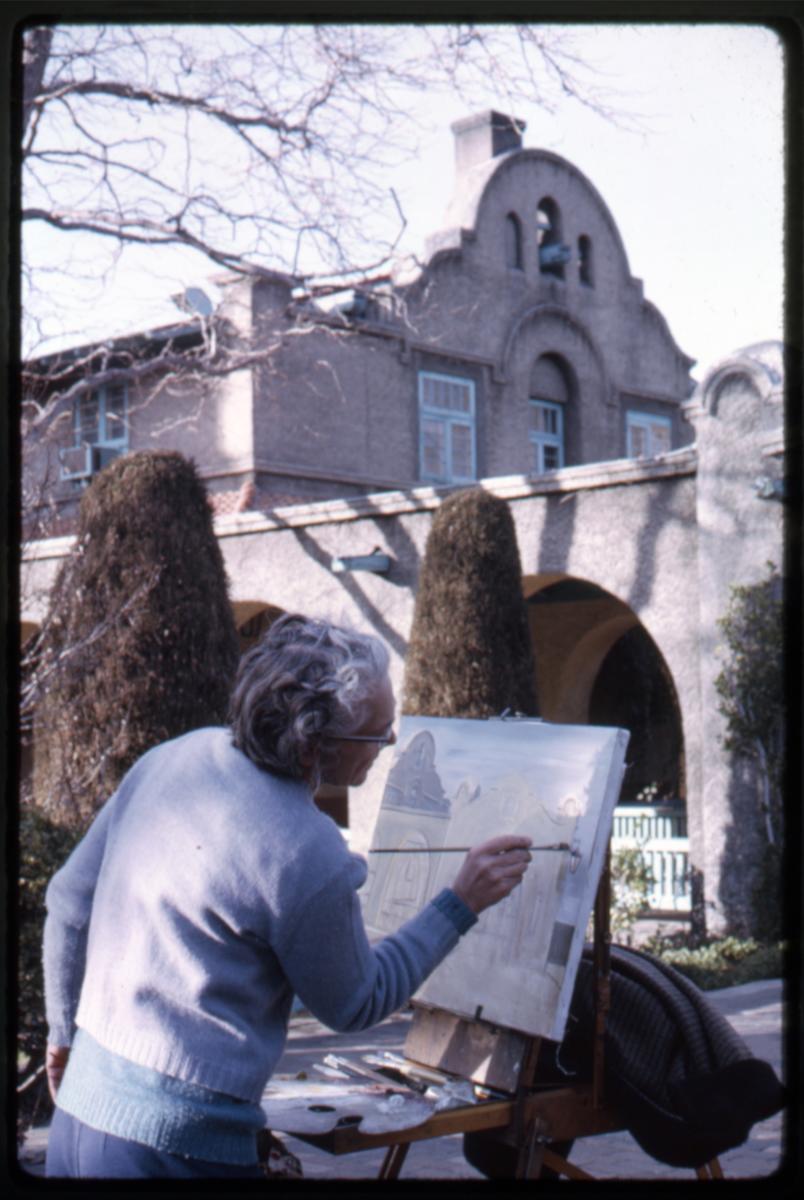
A painter at Albuquerque's Alvarado Hotel, 1969. Photograph past Walter McDonald, Albuquerque Museum, PA1996.006.136.
3 in particular stand up as exemplars—the Palace Photo Archives, the University of New Mexico's Center for Southwest Research, and the Albuquerque Museum. During COVID-19, most research has been limited to email, although UNM'southward centre has occasionally been able to offering by-engagement hours. All strive to digitize as many photos as possible, meaning that anyone with a computer tin can "visit" someday.
"Treatment real things, though, that's the fun part," says Cindy Abel Morris, the Center for Southwest Inquiry's pictorial archivist.
Jillian Hartke, digital archivist for the Albuquerque Museum, agrees. "I get all defenseless up in stories. I learn so many things and fall down then many rabbit holes. This chore is a smash."
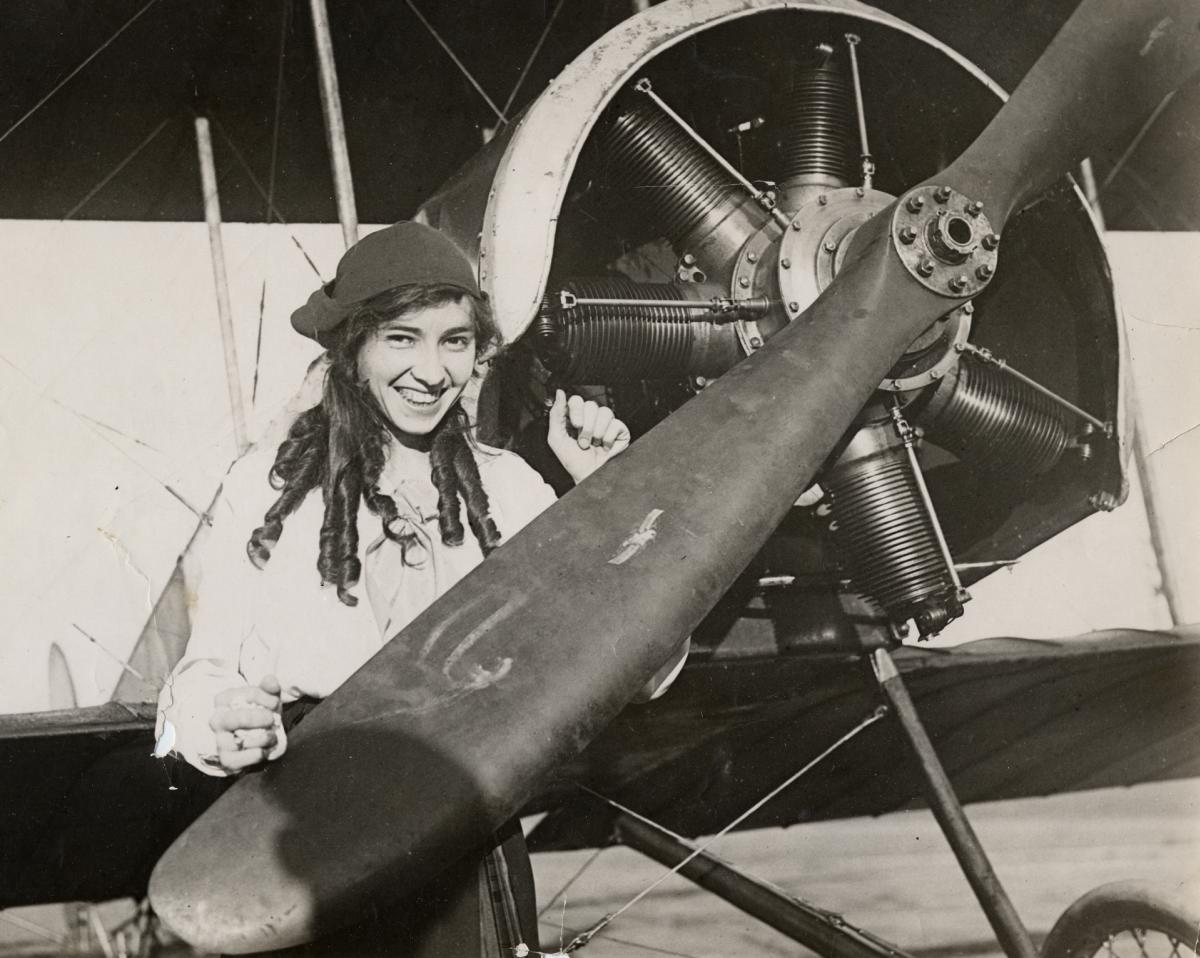
Pilot Katherine Stinson, ca. 1910–19. Center for Southwest Research, Katherine Stinson Drove, 000-506-0053.
KATHERINE STINSON FOUND A MEASURE OFearly on-19th-century fame as i of the nation'south first female aviators. Simply she wasn't simply a airplane pilot. She and her mother created a company to blueprint and build shipping. With her siblings, she started a flight school. She couldn't serve in World State of war I merely trained some 100 pilots who could. Then she founded the Society of Women Engineers.
Eventually, a bout with tuberculosis forced her to move to New Mexico. She constitute the cure at a Santa Fe sanatorium and met her hereafter husband, Miguel Otero Jr., son of a former territorial governor. She shifted to architecture and designed homes, including one for Dorothy McKibbin, the gatekeeper of the Manhattan Project.
Read More: New Mexico's state historian offers a fresh have on New United mexican states's rich and complicated by.
The Center for Southwest Research holds a few photos of Stinson. "She'due south someone that we should know more about and that more people should know of," Abel Morris says. "Something that many cultural and historical collections are dealing with is that a lot of the photos are of men. I'chiliad ever interested in collections by or almost women."
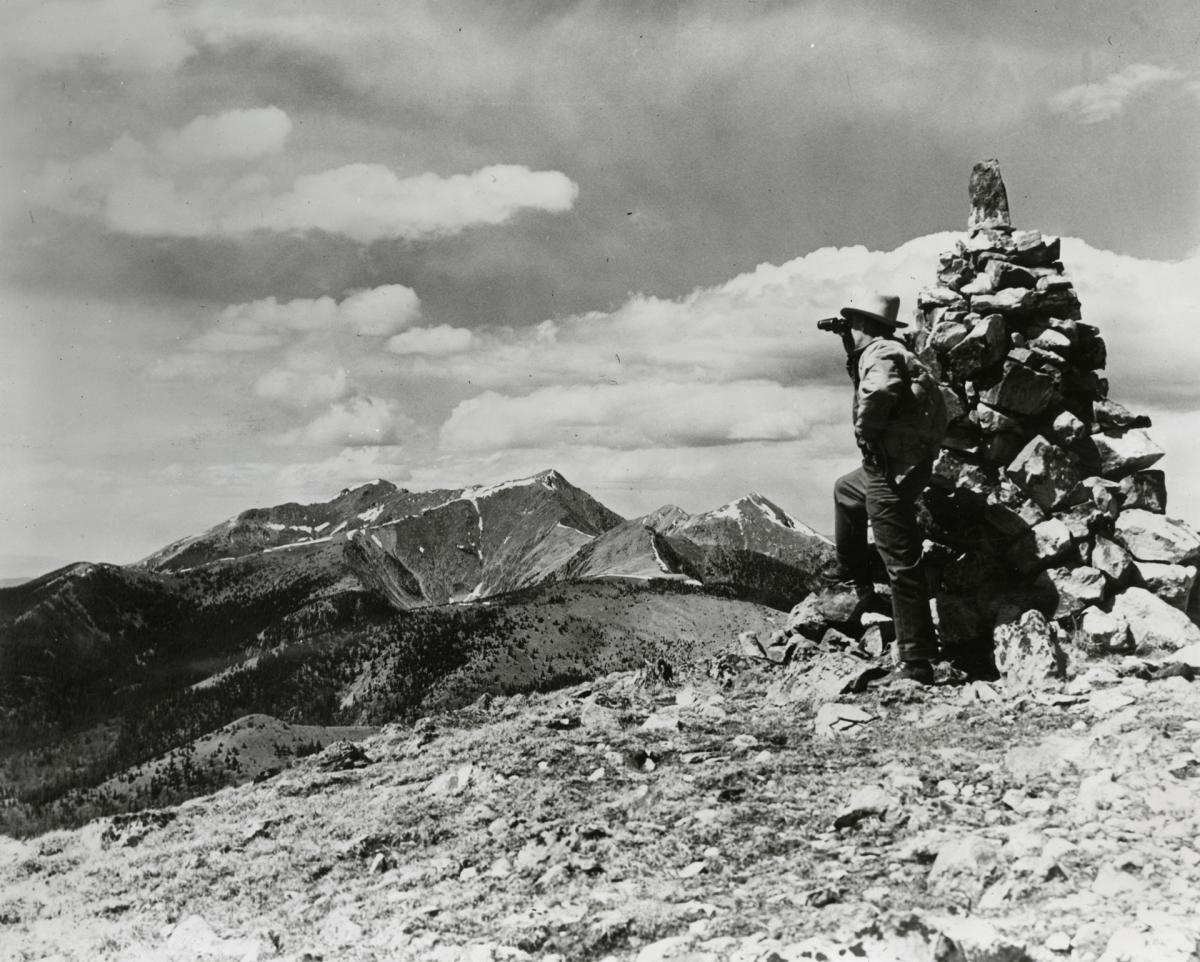
A man views Truchas Peak from the Pecos Mountains, New Mexico, 1940. New Mexico Tourism Bureau, New Mexico Magazine Collection, Palace of the Governors Photograph Archives (NMHM/DCA) HP.2007.xx.486.
The eye has amassed more than than 500,000 photographs. (They cascade in, more often than not from personal collections, faster than archivists tin can keep track.) Beyond the physical holdings, it oversees an online search portal hosting 155,968 digitized images (not counting historical documents, postcards, and maps) from 43 New Mexico organizations, including the Farmington Museum, New United mexican states State University Library, Roswell Museum & Art Center, and Corrales Historical Society. Birthday, the center's New Mexico Digital Collections website takes a mere seize with teeth of all the organizations' photos—but it's all the same enough to keep a history hound searching for days.
Yous can discover images of miners from Ratón to Silver Urban center, railroad workers, Harvey Girls, the Mexican Revolution, restaurants, fiestas and banquet days, lowriders and landscapes.
The Albuquerque Museum posted about 200 images to the site before investing in a stand-alone eastward-museum, which now tallies around 6,500 images. The bulk of the collective website's images come from the Palace's collections.
They are a sight to behold.
Housed in the lower level of the New Mexico History Museum's Fray Angélico Chávez History Library, the photographs fill up a warren of rooms containing shelves of boxes, rows of file cabinets, and a few freezers to preserve argent nitrate and acetate negatives. The drove began in the 1880s, when the Historical Society of New Mexico somehow intuited the futurity importance of the young medium and built relationships with people like famed explorer, artist, and photographer William Henry Jackson.
Read More: UNM's graduate plan in fine art photography was founded when there were few academic programs of its kind. Today information technology's ranked as one of the best in the nation—a place where photographers learn to break the rules.
There are daguerreotypes, tintypes, lantern slides, a solid chunk of photos from both New Mexico Magazine and The Santa Fe New Mexican , and, increasingly, built-in-digital pics. Despite the seeming glut, all three archives share a business organisation about the holes inside their collections. For generations, photography required money, and the people who could beget information technology brought their biases to conduct on their subjects.
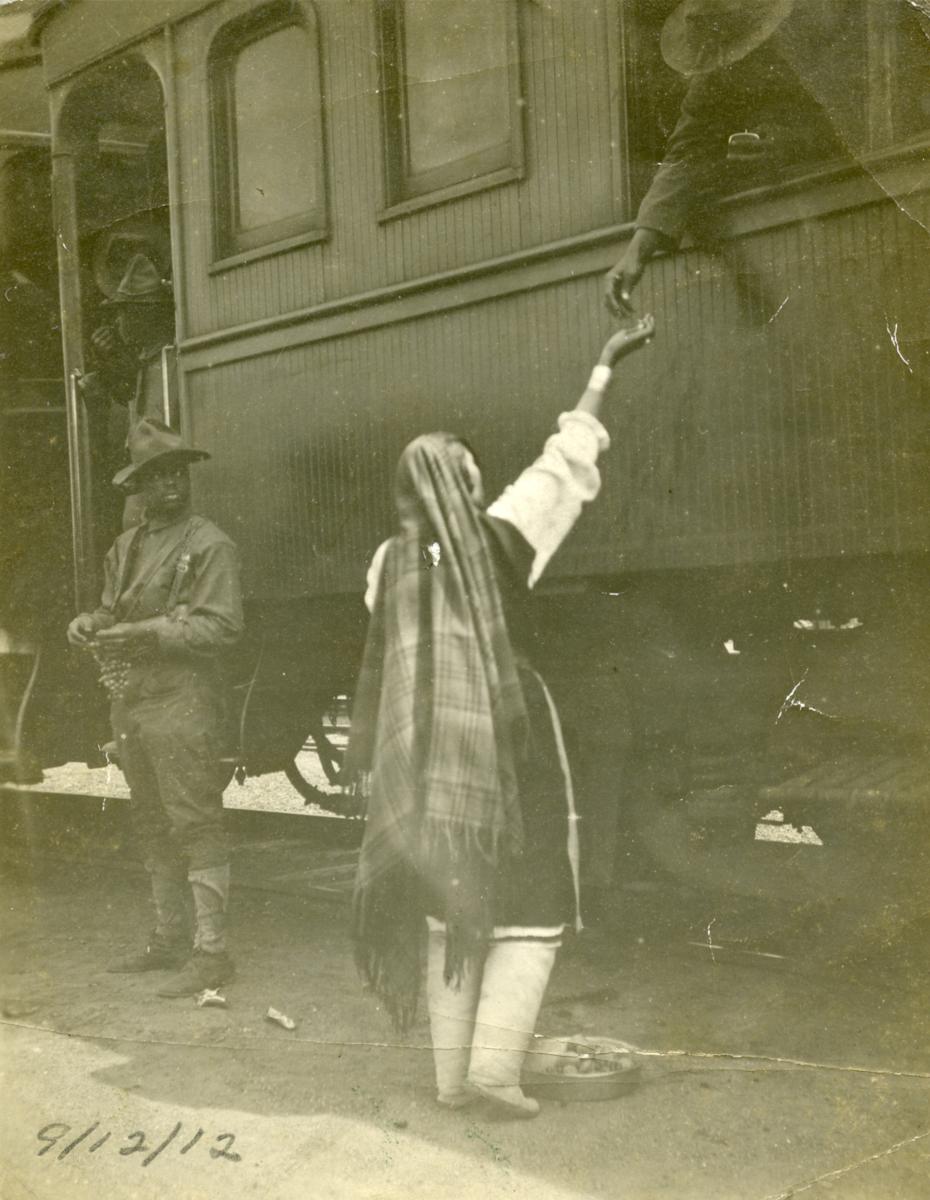
An Isleta Pueblo woman sells fruit to a soldier on a rider train, 1912. Albuquerque Museum, souvenir of H. Leonene Smith, PA1994.010.010.
Native people were posed in ways to uphold the "stoic Indian" stereotype, oftentimes in costumes and settings invented by the photographer. Their names, along with those of Hispanic villagers, usually went unrecorded. Other minorities were ignored altogether.
"Nosotros take but one photograph of a Chinese homo, a portrait in 1890," says Hartke. "We don't know who he is. We can always employ more women's history. Suffrage was a big research topic in the last few years, and I feel we were abysmal in providing images. We have 1914 footage of a parade, but only about xv seconds of information technology."
On the plus side, Albuquerque once boasted a handful of large portrait studios run by women—Alabama Milner, Eddie Cobb, Emma Albright—and the museum holds much of their piece of work. "They made it through the Low and Globe State of war II," Hartke says. "It's this incredible story of the gumption they had. They weren't just successful—these were the longest-running studios in the metropolis."
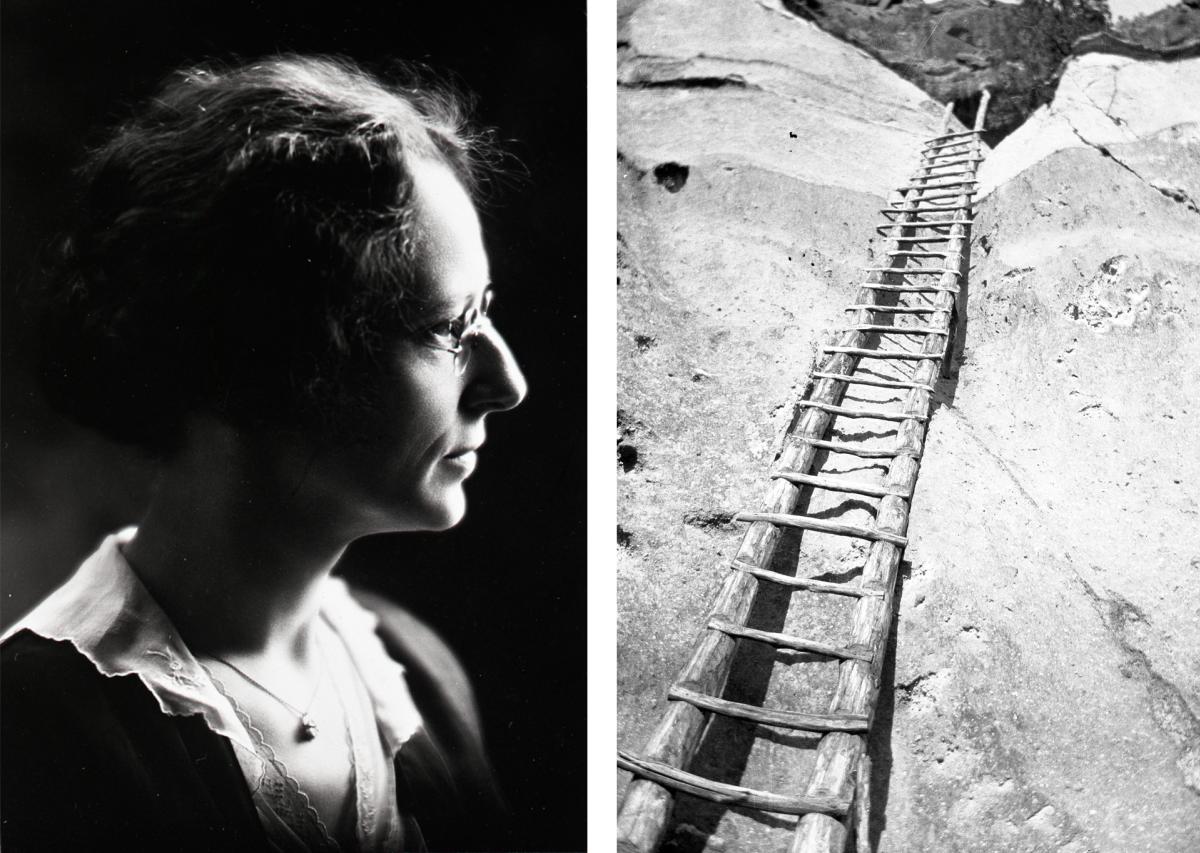
Alabama Milner'due south portrait, ca. 1930, Albuquerque Museum, gift of Margaret R. Herter, PA1994.015.012. An Alabama Milner photograph of the ladder at a cliff dwelling, ca. 1919–50. Centre for Southwest Research, Herter/Moon Drove, 2015-008(3)-0089.
PRIZEWINNING STATE Off-white ANIMALS ABOUND in the Albuquerque Museum'south digitized photos. There are too 1962 cancan dancers at the Carmine Bull Saloon, in the erstwhile Little Beaver Town theme park. The 1971 riots on the UNM campus barrel up against images of the whimsical lodgings that once dotted Route 66—the Mars Motel, El Jardin, and the Urban Motor Lodge ("recommended past Duncan Hines").
Rafts of photos characteristic the fronts of houses, a treasure trove for people who live in those dwellings today. And a 1969 series on the mundane activities of downtown Albuquerque—pedestrians, businesses, traffic—plough into a collage of fashion, automobile models, signage, and the stores that once drew daily shoppers.
People still take those photos, simply today they rarely bother to print them out and write downwardly what they draw or who was in them. That worries archivists. What will time to come historians use to illustrate our present, once information technology has passed?
"You're not going to detect a box of photos in the attic from 2010," Hartke says.
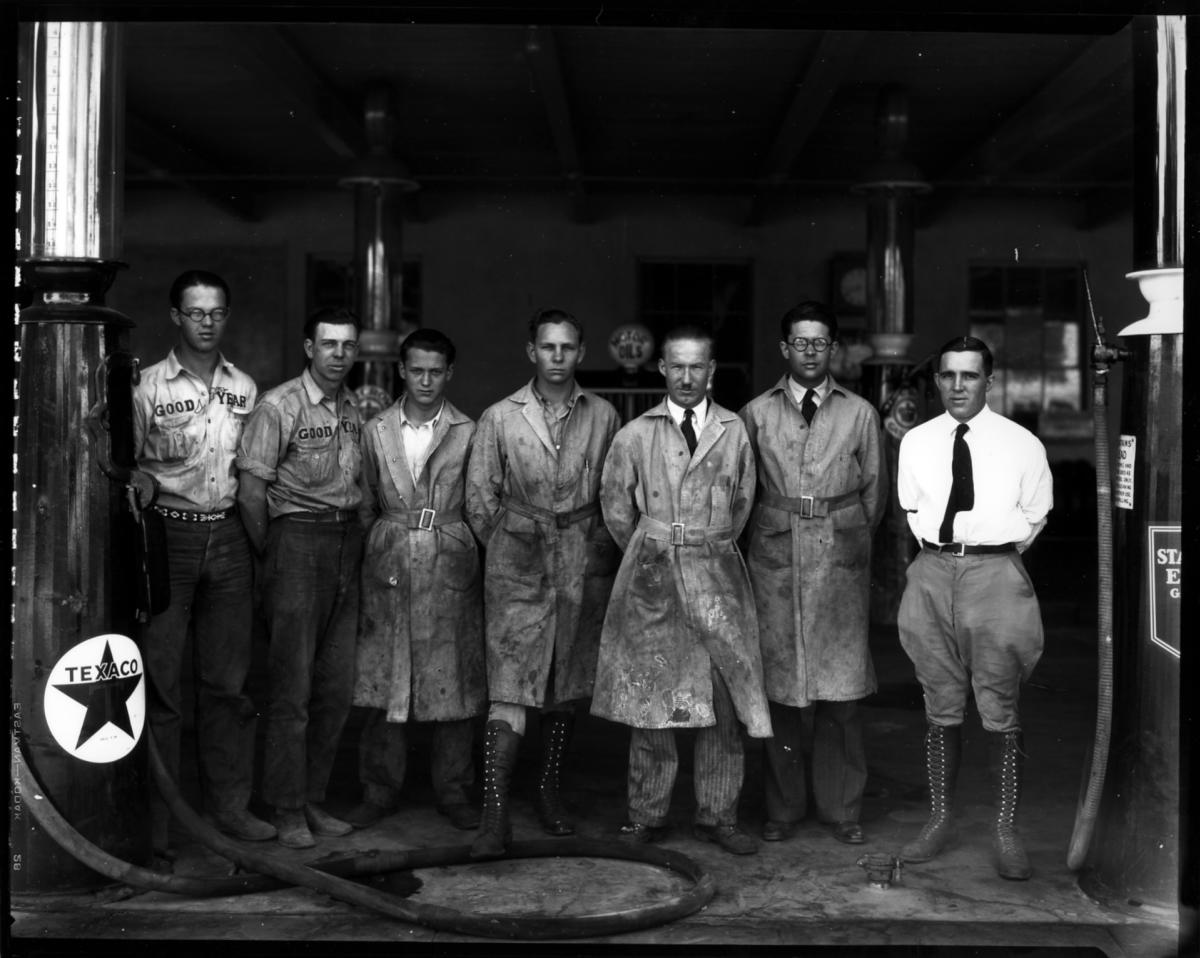
A circa 1920 Milner Studio shot of an Albuquerque service station. Albuquerque Museum, souvenir of Bob Davis, PA1992.005.812.
At its center, Abelbeck says, "photography captures the refraction of lite off a scene that once was. The images become minable for enquiry, but it depends on how well they're labeled. Once that information is discrete, piecing it back together is really hard."
Given that, archivists actively plot how to store digital photos in formats that last longer than the floppy disk era did, fifty-fifty as the pace of photography accelerates. "I was really hoping this twelvemonth I would be able, for my annual performance goals, to say, 'I've done five collections,' " Abel Morris says. "Only I've only washed two, because we tin't work on-site as much."
Read More: The 20th Annual New Mexico Magazine Photos of the Year
Hanging in the remainder are the stories of places that may non final, of people who will pass on, and of events that can affirm our humanity. The Albuquerque Museum holds a small collection of photos from the Dawson coal mine, almost Cimarrón, which earned infamy for a pair of disastrous explosions before closing and leaving little more than than a haunting cemetery behind. The photos were taken in 1910, before the accidents, and show the town physician running workers through safety drills.
"It's incredible to look at these images and know that some of those people really had to reply to a disaster a couple of years after," Hartke says. "There'south something really valuable about telling stories this way. When you come across a face up from the past, information technology's powerful."
PHOTOGRAPHIC MEMORIES
Visit the Center for Southwest Research, when open; by engagement.
Lookout man the Albuquerque Museum'south YouTube series Moving-picture show This to hear backstories of photos in the drove.
Follow the Palace of the Governors Photo Athenaeum on Facebook and Instagram for a daily array of historic images.
Go DIGITAL
Surf New Mexico Digital Collections online and Albuquerque Museum collections on their website.
Pb photo: Dave Jaramillo'due south son, Dave Jr., and wife, Irene, with his lowrider car, El Santuario de Chimayo, New Mexico, 1992. Photograph by Annie Sahlin, Dave'due south Dream series. Palace of the Governors Photo Archives (NMHM/DCA) HP.2013.12.31.
DOWNLOAD HERE
Posted by: carpenterthivalt.blogspot.com

Post a Comment for "Download Picture Of Woman In New Mexico UPDATED"